Vinaora Nivo Slider 3.xVinaora Nivo Slider 3.xVinaora Nivo Slider 3.xVinaora Nivo Slider 3.x

    DIETI Contact person / Partner: Giuseppe Scarpa

    Abstract

    The goal of the proposal is to apply Hyper Accuracy 3D (HA3DTM) technology in the Gynaecological surgery (endometriosis, endometrial cancer and so on) to reconstruct, form diagnostic imaging (RM, TC, ANGIOTC), three-dimensional model of the patient anatomy to improve pre-operative planning and consequently perform faster, more precise and safer robot-guided surgery.  The study will reveal specific indications of pathologies and surgical procedures for which HA3DTM technology is more effective.

    Objectives

    The objectives are:

    • to develop a tool to improve pre-operative planning;
    • to improve robot-guided surgery towards enhanced robot autonomy;
    • to understand the usefulness of the new technology compared to the state of the art.


    DIETI Contact person / Partner: Nicola Petra

    Abstract

    Computer assisted surgery has many advantages (minimized post-operative pain; sped up recovery; increased comfort for the surgeon; improved surgery's performance; reduced haemorrhaging; reduced risk of infections). There is however still a long way to go towards partial or full automation surgical interventions while the actual research activity is based on automating basic surgery.
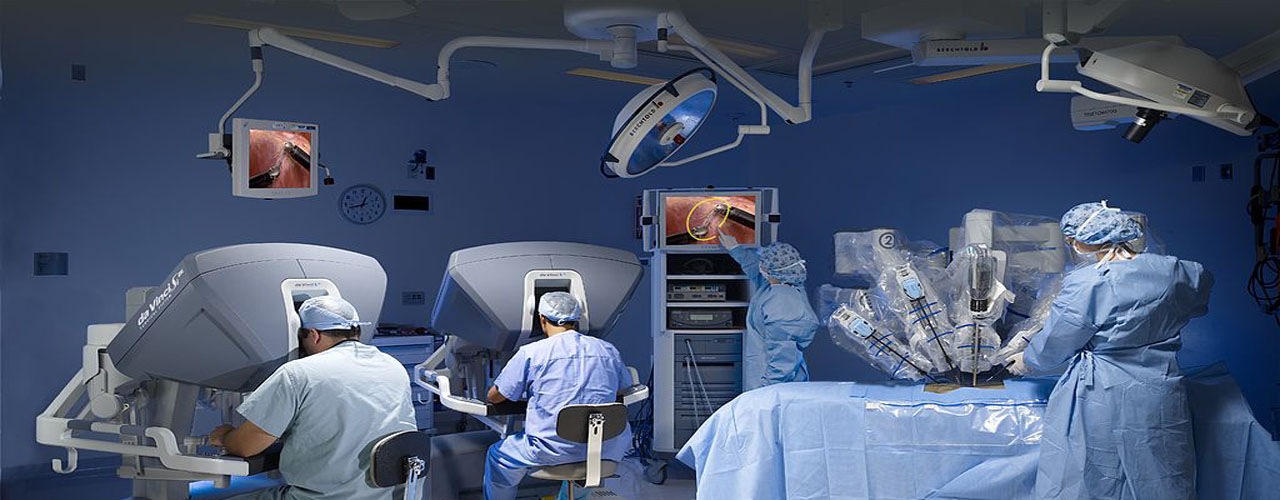
    The research activity will develop the hardware accelerators and the interfaces that will improve speed and accuracy of the atomic surgery tasks devised by other research groups that are part of the project. These tasks are based on the video elaboration of the Da Vinci stereo camera (the Da Vinci robot is available for the research group). Processing intensive tasks for video processing, feature extraction and tracking, will be leveraged through the use of high performance dedicated circuits.

    Objectives

    The research activity will assist in the automation of atomic surgical actions that joint together form a complete surgery activity. As an example, the actions of cutting, suturing, tissue repositioning, bone drilling, and tool exchange.

    The project aims at developing:

    • real-time visual sensing and elaboration of the scene;
    • to track laparoscopic instruments;
    • to automatically move the camera with no explicit human direction;
    • to start performing simple autonomous tasks;

    The considered test scenario will be the urological surgeries.

    The research activity is expected to deploy hardware accelerators implemented on FPGA to assist the control and tracking algorithms. The initial steps will be the extraction of stereo data from the cameras (not an easy task due to the reduced volume of the laparoscopic surgical field) and the track of the tools.


    DIETI Contact person / Partner: Many /Guido De Sena

    Abstract

    A socially Assistive Robot is intended as an assistive tool which can complement the therapist in training and rehabilitation, can be used for remote monitoring and assisting the user, and constitutes a playful agent to better engage the participants and relief from anxiety. In order to achieve these goals, it requires the ability of multi-modal perception, emotion expression, verbal and non-verbal communication, adaptive control, decision-making, and learning mechanisms.

    Objective

    The aim of the research activity is to develop, validate, and test in hospitals and homes interaction strategies for socially assistive robots in healthcare and home environments and adapt to each individual’s capabilities. Goal of the interaction is defined by considering the assistive role the robot has to play with respect to the patient.


    DIETI Contact person / Partner: Bruno Siciliano /  Raffaele Russo (Pineta Grande Hospital)

    Abstract

    Assistive robotics is a research field meant to help impaired individuals recovering motor functions or coping with Activities of Daily Living (ADL). The rehabilitation devices considered in the proposed research are upper-limb exoskeletons. Interaction control is the main core topic in this scenario as well as adaptive control, multimodal perception, sensory fusion and smart/friendly user control interface. The goals of the proposed activity are the development of a multi-joint dynamics model for upper-limb exoskeleton and the development of assistive control systems that can customize the amount of assistance according to the patient recovery advancement as well as the development of friendly control interfaces using multimodal sensory feedback. Open problems are related to sensitive and robust adaptation of the robotic system to the patient and safety issues.

    Objective

    The scientific research goals of the proposed PhD activity are: 

    • to develop a multi-joint dynamics model for upper-limb exoskeleton for rehabilitation purposes;
    • to develop adaptive control algorithms for automatic tuning of the level of assistance of upper-limb exoskeletons according to the patient recovery advancement;
    • to optimize the assistive profile delivered by an exoskeleton through techniques of human-in-the-loop optimization and AI techniques.


    DIETI Contact person / Partner: Silvia Rossi

    Abstract

    Remote Surgical Training (ReST) on Da Vinci platforms consist in dislocating tutor and second console in an operation room (OR) adiacentent to the Operation Room where the trainee is. 

    Main Steps:

    1. Use the environmental video camera of the main Operation Room also connecting it to the tutor console in the adjacent room so that (s)he can see and monitor everything that happens;
    2. Perform remotely training tests;
    3. Evaluate the data and performance by the whole OR team;
    4. Make a statistical study of the data collected and prepare a detailed report on the results;

    Objective

    The research focuses on human factors and pedagogical effects of remotely training. The intent is to evaluate how the human-machine relationship for the trainee changes without the physical presence of tutor in the main OR. Methods to facilitate communication between tutor and trainee with respect to the operating room environment will be explored. The trainee’s performance score will be evaluated.


    Subcategories

    Page 1 of 2

    Privacy Policy